
Contract Manufacturing vs Custom Moulding vs Fabrication: Which Model Fits


Three different ways to get plastic parts made - each suited to different products, volumes and stages of a project. Here's how to pick the right one.
In Australian plastics manufacturing the same project can land in three very different commercial models depending on what you actually need. Confusing them is one of the most common reasons buyers end up with the wrong supplier, the wrong cost structure and the wrong relationship.
This page explains the three models - contract manufacturing, custom moulding and fabrication - and how to know which one fits your project.


Combining full ISO certification with DISP accreditation, B&C Plastics provides high-quality, secure, and traceable plastic injection moulded components engineered for reliability and performance.
The three models at a glance
| Model | What you get | Best when… |
|---|---|---|
| Contract manufacturing | Ongoing supply of finished parts to a forecast or contract | You have a stable product and want a long-term supply partner |
| Custom moulding | Tooling and production of a part designed for your business | You have a defined design and need it made repeatedly |
| Plastic fabrication | Parts cut, machined or formed from plastic stock - no tooling | Volumes are very low or the geometry suits machining better than moulding |
Contract manufacturing - explained
Contract manufacturing is a longer-term commercial relationship in which we manufacture and supply parts to your business on an ongoing basis. It usually includes everything from tooling ownership and management to forecast-based scheduling, finishing, assembly, packaging, quality reporting and held stock.
Most of B&C Plastics' work falls into this category. We are most useful to customers when we are part of their supply chain rather than a transactional vendor.
What contract manufacturing typically includes
Tooling owned by you, stored and maintained at our facility
Production scheduled against a 6 to 12 month rolling forecast
Locked conversion pricing for the contract period, with transparent material indexation
Finishing, decoration, assembly and packaging where required
Held finished-goods stock (vendor-managed inventory) for high-volume customers
Regular quality and on-time-delivery reporting
A dedicated project manager and clear escalation path
When contract manufacturing fits
Your product is stable and you expect to keep selling it for years
Volumes justify a contractual commitment from both sides
You want predictable supply, predictable pricing and a single accountable partner
You are running multi-SKU programs that benefit from coordinated production
Compliance, traceability or regulated-industry requirements need to be managed continuously
Contract manufacturing is where partnership economics start to work in your favour. The longer the relationship, the better the cost, quality and responsiveness usually get.
Custom moulding - explained
Custom moulding is the production of a part designed specifically for your business, using a tool we (or you) own. The relationship can be transactional - a single tooling build and a defined number of production runs - or it can evolve into ongoing contract manufacturing.
Custom moulding is the right starting point when you have a design that needs tooling, but you are not yet ready to commit to a long-term contract. Many of our largest contract customers started here.
What custom moulding typically includes
DFM review and tooling design
Tool build (in-house or via vetted partner toolmakers under our oversight)
Tool trial, validation and first-off sample sign-off
Production runs scheduled per purchase order
Optional finishing, assembly and packaging
When custom moulding fits
You have a defined product but uncertain long-term volumes
You are launching a new product and want to start with a single tooling commitment
You expect occasional production runs rather than constant supply
You are evaluating B&C as a potential long-term partner before committing
Plastic fabrication - explained
Plastic fabrication is the production of parts by cutting, machining, routing or thermoforming plastic stock material - sheet, rod, tube or block - without any tooling at all. It is the right answer when volumes are too low to justify a mould, or when the geometry suits machining better than moulding.
At B&C Plastics, fabrication sits alongside our injection moulding capability. Our precision engineering team handles CNC machining, cutting and finishing in engineering-grade plastics, often as part of larger projects that combine moulded and machined components.
What plastic fabrication typically includes
CNC machining or routing from sheet, rod or block stock
Cut-to-size precision manufacturing for industrial and infrastructure applications
Edge finishing, drilling, threading and assembly features
Lower per-part cost at low volumes, with no tooling investment
Ability to produce one-off parts or small batches in days rather than weeks
When plastic fabrication fits
Volumes are below the threshold where moulding tooling makes sense (often under 200 - 500 parts)
The geometry is suited to machining (flat plates, blocks, simple profiles)
You need engineering-grade plastics like UHMWPE, polycarbonate or acetal in custom shapes
Lead time is critical and waiting for a tool is not viable
The part is a prototype, jig, fixture or one-off production component
How to decide between the three models
The right answer depends on three questions: how many do you need, how often, and how stable is the design?
| If you need… | Best model |
|---|---|
| 1 - 200 parts, one-off, design might evolve | Plastic fabrication or 3D printing |
| 1,000 - 100,000 parts, defined design, occasional runs | Custom moulding |
| 50,000+ parts per year, stable design, ongoing demand | Contract manufacturing |
| Mix of moulded and machined parts in a single product | Combination - we can manage both |
How the models can work together
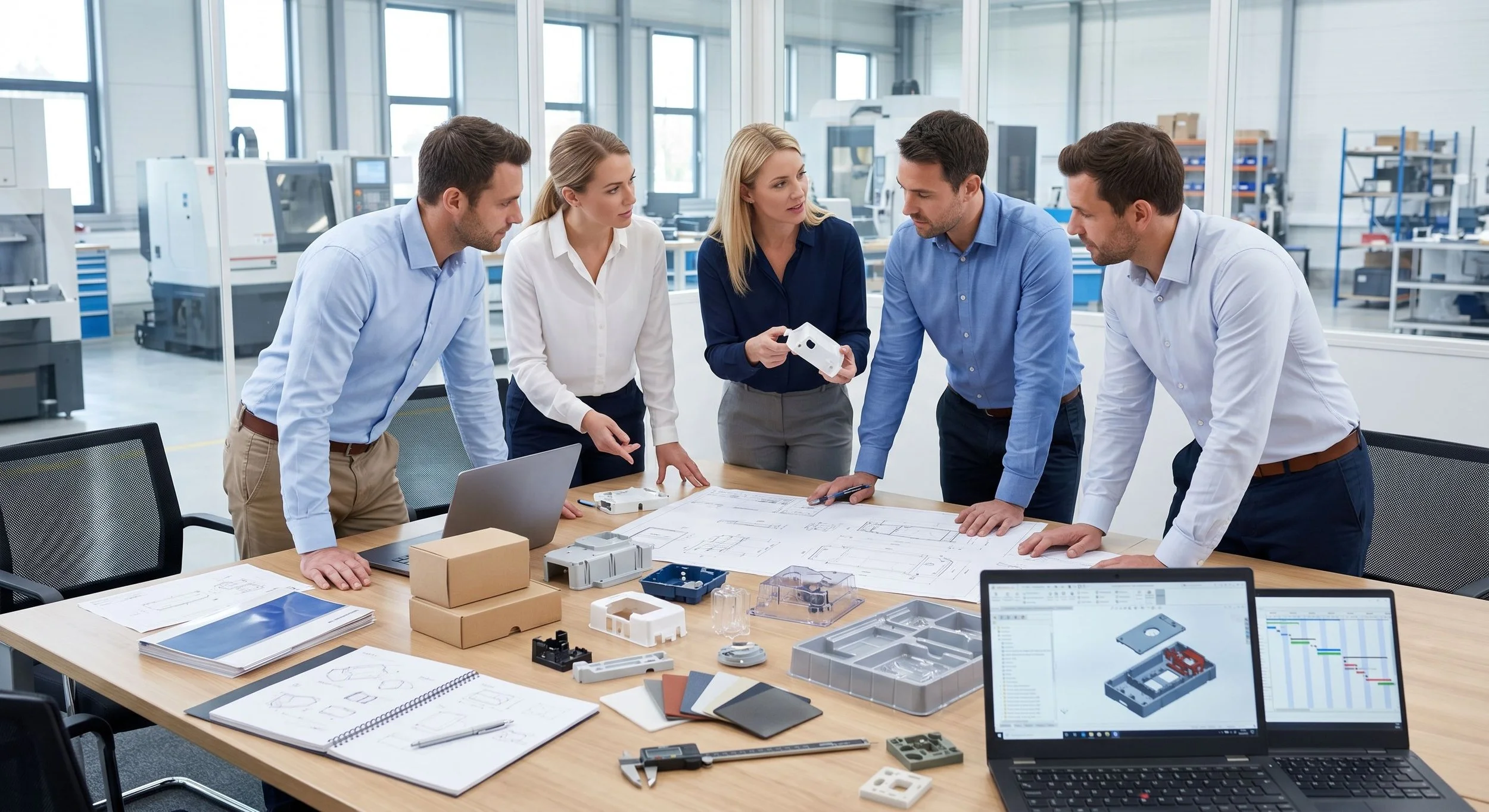
These models are not mutually exclusive, and many B&C customers use a combination at different stages of a product lifecycle:
Start with plastic fabrication or 3D printing for prototypes and low-volume early sales
Move to custom moulding once the design is locked and forecast supports tooling
Transition to contract manufacturing as the program matures and volumes grow
Use fabrication alongside moulding for low-volume accessories or service parts
Because we have all three capabilities under one roof, the transition between models is seamless - same project manager, same engineering team, same quality system.
Frequently asked questions

-
Yes - and many of our customers do. As your program matures and volumes prove themselves, we can move the relationship onto a forecast-based contract with locked conversion pricing. There is no penalty for starting small.
-
Yes. Many products use both - for example, a moulded housing with a CNC-machined mounting plate. We can quote, manage and supply the whole assembly as a single line item.
-
No. We will happily start with a single project and let the relationship grow naturally. Contracts are tools to give both sides certainty - they should be entered when both sides see the value, not as an entry barrier.

Ready to talk to an engineering-led plastics partner?
Whether you have a fully developed brief or a rough concept, the B&C Plastics team can help you scope, design, prototype, tool and manufacture in one place - right here in Australia.
Call us on (07) 3208 0544
Email enquiries through our contact page
Or visit our Meadowbrook facility, 20 minutes south of Brisbane
Honesty, quality and partnership - today, tomorrow and every day.