
Design for Manufacture for Plastic Parts


Why DFM is the difference between a design that looks good in CAD and a part that actually moulds, assembles and lasts in the real world.
Design for Manufacture - usually shortened to DFM - is the practice of refining a part's design so it can be tooled, moulded, finished and assembled efficiently, repeatably and at the right cost. It is one of the most important and most underused stages of plastic product development.
Done well, DFM saves money, speeds time-to-market and reduces risk. Done late or skipped, it shows up as tooling rework, scrap parts, warranty claims and quiet engineering frustration.
A useful rule of thumb: every dollar spent on DFM at the design stage saves roughly ten dollars at tooling and a hundred dollars in production.


Combining full ISO certification with DISP accreditation, B&C Plastics provides high-quality, secure, and traceable plastic injection moulded components engineered for reliability and performance.
What DFM actually involves
Plastic injection moulding is a specific manufacturing process with specific physical constraints. DFM is the discipline of designing within those constraints - and where possible, using them to your advantage.

Wall thickness and uniformity
Plastic parts cool from the outside in. If walls vary in thickness, they cool at different rates, which causes warpage, sink marks, internal stress and dimensional drift. Good DFM keeps walls uniform within the design and cores out thick sections to maintain consistent thickness.

Draft angles
Every surface that runs in the direction the part is ejected from the mould needs draft - a slight angle, usually between 0.5 and 3 degrees - so the part releases cleanly. No draft means scuffed parts, longer cycles, and shorter tool life. DFM adds draft early so it does not have to be retrofitted later.

Ribs, bosses and structural features
Ribs add strength without adding mass. Bosses provide mounting points for screws, threaded inserts and assembly. Both need careful proportioning - too thick and they cause sink, too thin and they fail under load. Good DFM places these features deliberately and at the right dimensions.

Gate, runner and ejector strategy
Where plastic enters the cavity (the gate), how it flows in (the runner), and how the part is pushed out (the ejector) all influence final part quality. Cosmetic surfaces, weld lines, ejector marks and parting lines need to be planned around the part's appearance and function.

Material selection
Different polymers behave very differently. A geometry that works in polypropylene may fail in polycarbonate, and vice versa. DFM includes selecting the right material for the application - balancing performance, cost, recyclability and processability.

Tolerance and fit
Plastic parts cannot hold the same tolerances as machined metal. Designing for realistic plastic tolerances avoids costly rework. Where tight fits are critical, we design in features (like crush ribs or slip-fit reliefs) that do the job without demanding impossible precision.

Assembly and joining
How parts come together matters as much as how they are made. Snap-fits, ultrasonic welds, threaded inserts, screw bosses and adhesives all have their place. DFM picks the right joining strategy for the volume, the application and the lifecycle of the product.
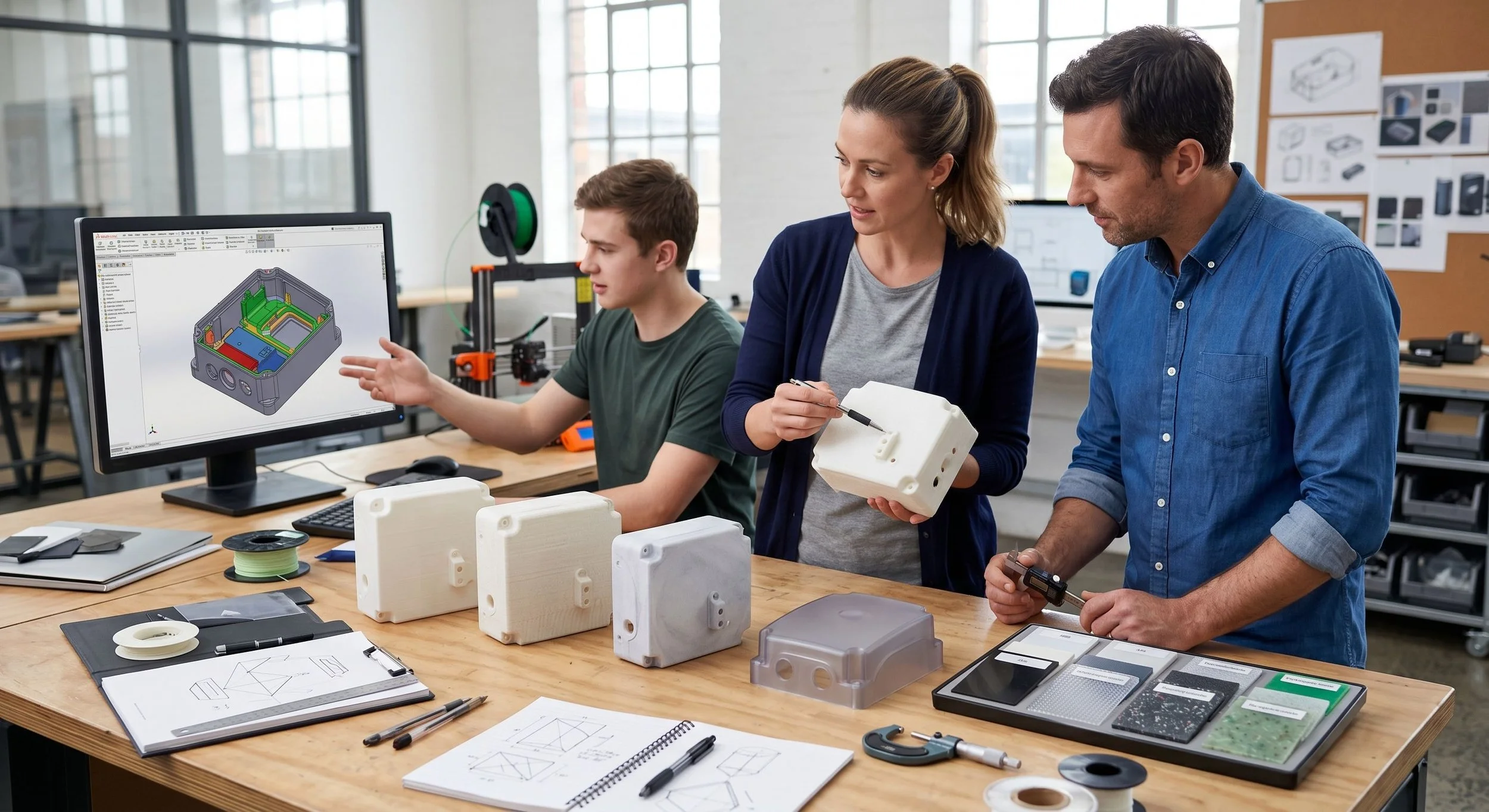
DFM tools we use at B&C Plastics
Our engineering team uses both judgement and software to validate designs before tooling is committed.
Mould flow analysis: simulates how plastic fills the cavity, where weld lines form, and where pressure or temperature problems will occur
Finite Element Analysis (FEA): predicts how the part responds to loads, drops, vibration or thermal stress
Tolerance stack analysis: confirms that mating parts will actually fit when manufactured
Draft and undercut audits: make sure every surface releases from the mould cleanly
Cost modelling: links design choices to tooling complexity, cycle time and unit cost
Material trade-off matrices: compare polymer options against performance, cost and recyclability
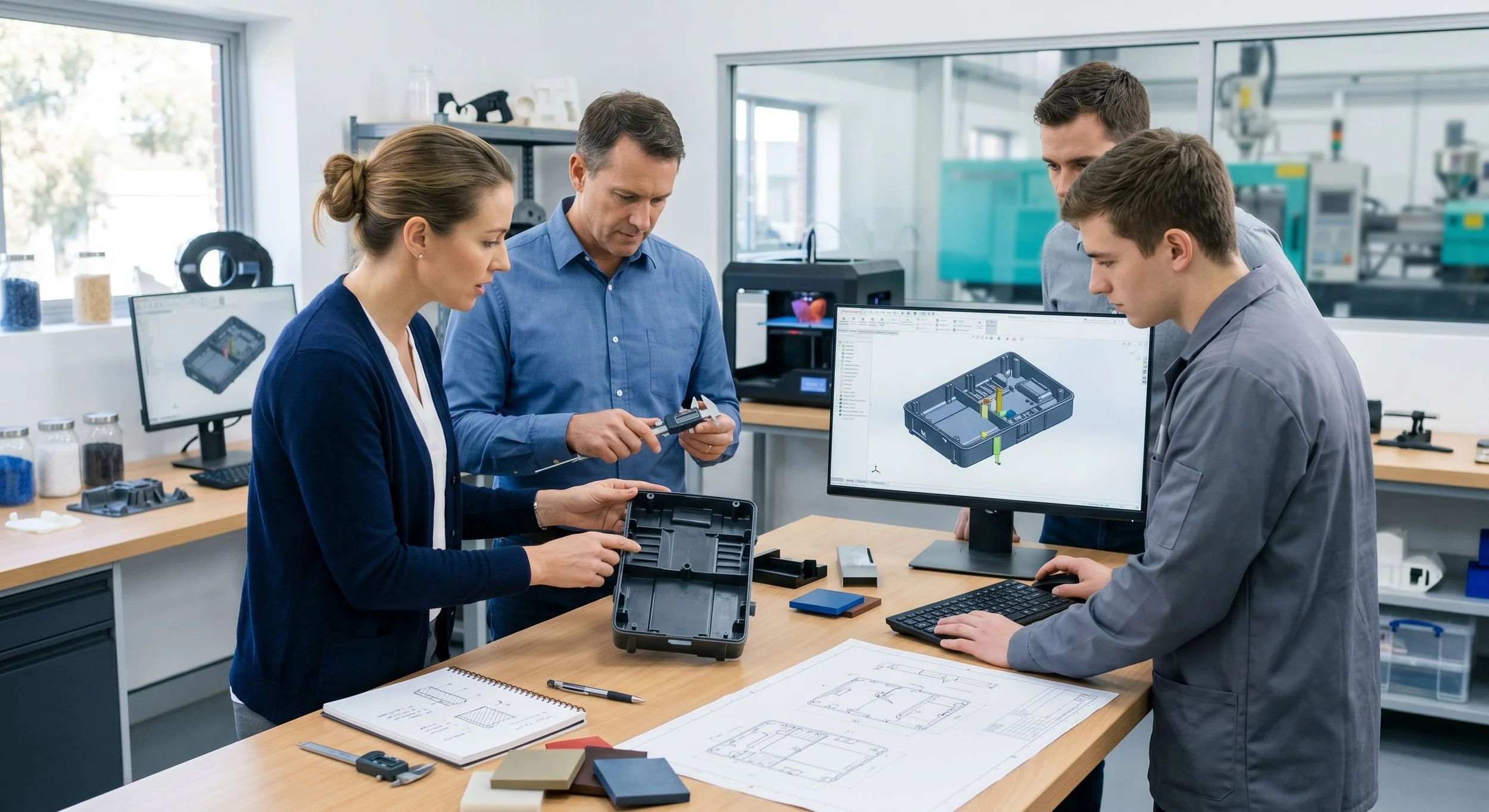
DFM for circular and recycled materials
Designing for manufacture and designing for circularity are not separate disciplines. Choices made during DFM directly affect whether a part can be recycled at end of life - or made from recycled content in the first place.
At B&C Plastics, our DFM process actively looks for opportunities to:
Reduce the number of polymer types in a single product (so it can actually be recycled)
Design for disassembly so components can be separated at end of life
Specify recycled-content polymers where performance allows
Eliminate adhesives, paint and overmoulding where they prevent recycling
Reduce part mass without compromising function
This is how we lead 100% of circular manufacturing conversations among Australian moulders - by building it into design, not bolting it on afterwards.

What you receive from a B&C DFM review
After a formal DFM review, you receive a written report covering:
Mould flow analysis with fill pattern and weld line predictions
Recommended changes with rationale and risk-rating
Material recommendation including recycled-content options where viable
Tooling complexity assessment and indicative cost band
Cycle time estimate and unit cost projection
Bill of materials and assembly notes
Sign-off-ready CAD files for tooling release

When to bring us in for DFM
The earlier the better. Ideally we are involved before the design is locked, so we can shape the geometry as it develops. We can also DFM-review a finished design before tooling - and frequently do, especially for clients re-shoring product from offshore.
Even a one-day DFM review on a finished design can pay for itself many times over in tooling savings and reduced production risk.
Frequently asked questions

-
Yes. We do this regularly. We can issue a confidential DFM report that flags risks, opportunities and suggested changes - without altering the design unless you ask us to.
-
For projects we are tooling and producing, DFM is included in the engineering scope. For standalone DFM reviews we charge a flat fee depending on the part complexity. Get in touch and we will scope it for you.
-
We work natively in SolidWorks and accept STEP, IGES, Parasolid, native SolidWorks, and most other major formats. We supply native files back to you for any design we develop.
Ready to talk to an engineering-led plastics partner?
Whether you have a fully developed brief or a rough concept, the B&C Plastics team can help you scope, design, prototype, tool and manufacture in one place - right here in Australia.
Call us on (07) 3208 0544
Email enquiries through our contact page
Or visit our Meadowbrook facility, 20 minutes south of Brisbane

Honesty, quality and partnership - today, tomorrow and every day.