
How We Work: Projects, Volumes & Supply Models

A clear, honest explanation of the project sizes we suit best, the volumes we manufacture, the lead times you can expect and the commercial models we work to.
Choosing a plastics manufacturing partner is partly about capability, but it is also about fit. The wrong-sized supplier - too small to scale with you, too large to care about you - creates friction even when the work itself is good. This page lays out, transparently, who B&C Plastics is built to serve and how a typical engagement works.

Combining full ISO certification with DISP accreditation, B&C Plastics provides high-quality, secure, and traceable plastic injection moulded components engineered for reliability and performance.
Who we are built to serve
B&C Plastics is best positioned for projects where engineering, quality, traceability and partnership matter as much as price per part. Our most successful client relationships share some common patterns:
Volumes between 10,000 and 1,000,000+ parts per year per SKU
Mid-to-high complexity parts, often with assembly, finishing or compliance requirements
Annual contract or forecast-based supply, not one-off transactions
Multi-SKU programs where we manufacture a family of parts for a single brand
Customers who value local supply, traceability and IP protection
Project sizes we suit
We deliberately keep enquiry doors open across a wide range of project sizes. The right model depends on what you are trying to achieve.
| Project type | Typical scope | What you get from B&C |
|---|---|---|
| First-project / pilot | Single SKU, < 50,000 units / year |
|
| Mid-volume program | 1 – 10 SKUs, 50,000 – 500,000 units / year | |
| High-volume contract supply | Multiple SKUs, 500,000+ units / year | |
| Re-shoring program | Existing offshore parts brought local | |
| NPD / development | New product, no tooling yet |
Volume capability
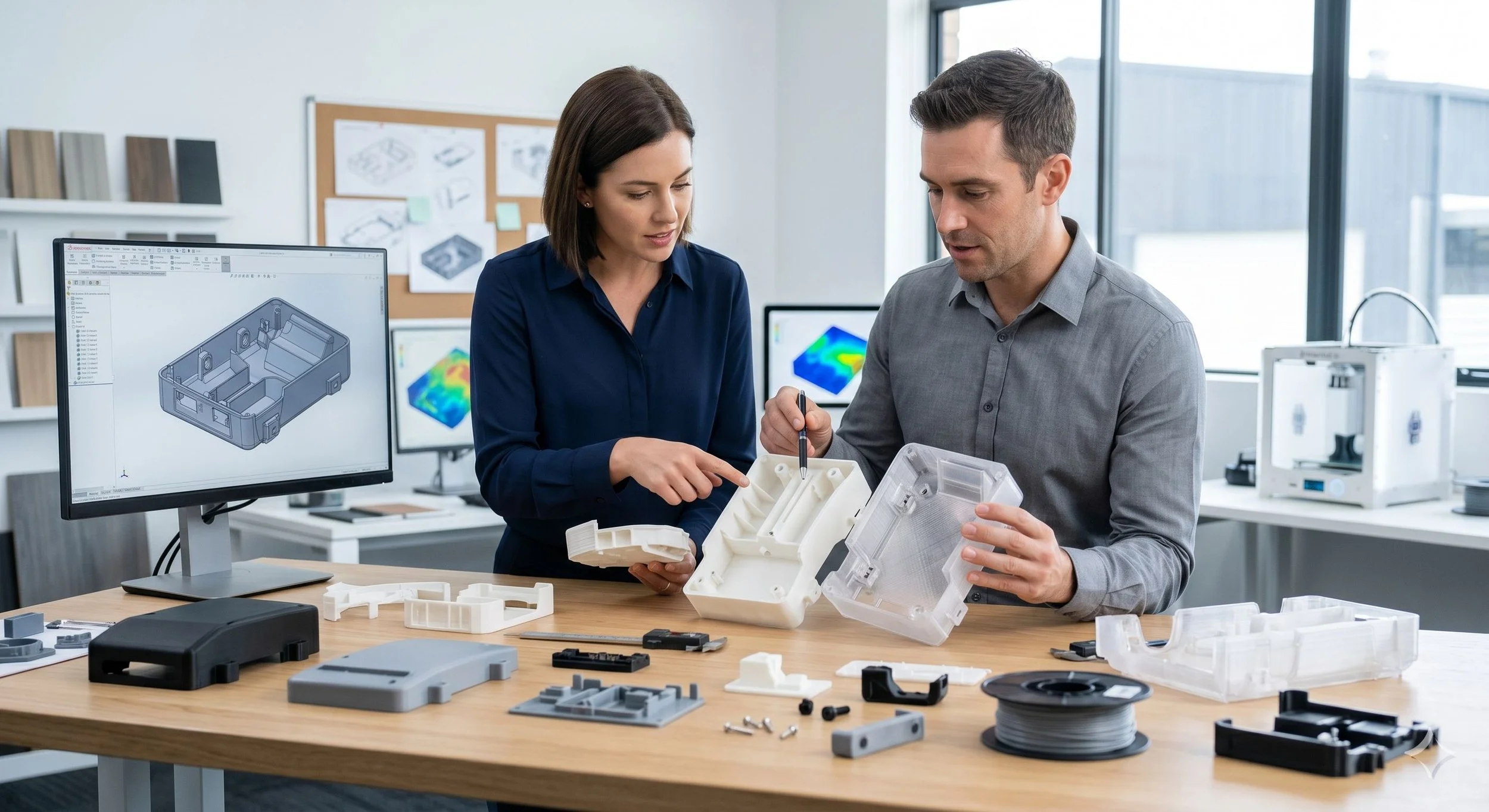
Our Meadowbrook facility runs an in-house fleet of injection moulding machines spanning 50 to 600 tonne clamp force, with shot weights from 1 gram to 2.3 kilograms. Annual production capacity exceeds 50 million moulded components.
That gives us flexibility across a wide range of part sizes and run lengths, and the ability to scale a successful program without you having to change suppliers.
Minimum batch: from 1,000 units (lower for some specialty applications)
Typical run: 10,000 – 250,000 units per scheduled run
Maximum annual volume: no fixed cap - we scale capacity to match committed forecasts
Lead times
Lead times depend on whether tooling already exists and how the project is being scheduled.
| Scenario | Typical lead time |
|---|---|
| Existing tool, scheduled production run | 2 – 3 weeks |
| Existing tool, urgent unscheduled run | 1 – 2 weeks (subject to capacity) |
| Existing tool, transferred from another supplier | 4 – 6 weeks (including validation) |
| New tool, design-released, ready to build | 2 – 8 weeks |
| New product, full design and tooling required | 4 – 6 months end-to-end |
Commercial engagement models
We have three primary engagement models. They are not mutually exclusive - some clients use a combination.

1. Project-based engagement
You engage us for a defined piece of work - usually a new product development, a tooling build, a re-shoring project or a one-off production run. Scope, deliverables, milestones and price are agreed up front. Best for early-stage products and discrete projects.

2. Forecast-based contract supply
You provide a 6 to 12 month rolling forecast, we plan production capacity around it, and we deliver to scheduled drop dates. Pricing is locked for the contract period. This is our preferred model for ongoing programs because it gives both sides certainty.
3. Vendor-managed inventory (VMI)
For high-volume customers we can hold finished goods stock against an agreed minimum and replenish on consumption signals. Useful for customers who want "take-what-you-need" supply without holding their own inventory.
What we ask of customers
Strong supply relationships go both ways. To get the most out of B&C as a partner, customers typically:
Provide forecasts where possible - even rough ones help us schedule
Engage us early in design changes so we can flag manufacturing impact
Give us reasonable warning on volume changes (up or down)
Work to agreed payment terms - we are happy to discuss what suits you
Share end-customer feedback with us - we use it to improve the product

When B&C may not be the right fit
In the spirit of transparency, here is when we are probably not the lowest-friction choice:
Very large volumes of very simple, uncomplicated commodity parts where price-per-part is the only criterion (offshore is usually cheaper)
One-off production of a single part where tooling cost cannot be justified (try CNC or 3D printing first)
Projects with no design and no willingness to invest in development
If we are not the right fit, we will tell you - and where we can, we will point you to someone who is.
Frequently asked questions

-
It depends on the project. There is no universal MOQ. See our dedicated MOQ page for detail on how we set minimums and why.
-
Almost certainly yes. Our facility has substantial spare capacity for growth, and we have a track record of scaling production with customers as their programs expand. If a particular SKU outgrows our practical capacity, we will tell you long before it becomes a problem.
-
For contract supply customers we provide regular reporting on on-time delivery, quality (PPM), and any agreed performance metrics. The exact reporting cadence and content is set up at the start of the relationship.
Ready to talk to an engineering-led plastics partner?
Whether you have a fully developed brief or a rough concept, the B&C Plastics team can help you scope, design, prototype, tool and manufacture in one place - right here in Australia.
Call us on (07) 3208 0544
Email enquiries through our contact page
Or visit our Meadowbrook facility, 20 minutes south of Brisbane

Honesty, quality and partnership - today, tomorrow and every day.