
Minimum Order Quantities for Custom Plastic Manufacturing

Why MOQs exist, how they are set, and how to think about them when you are scoping a new plastic project.
"What's your MOQ?" is one of the first questions we get from new customers. The honest answer is: it depends. There is no single minimum order quantity at B&C Plastics, because every project has a different combination of part size, material, tooling, complexity and ongoing forecast. What we can do is explain how MOQs are calculated, what they typically look like, and how to design a project so the MOQ works in your favour.
Why MOQs exist at all
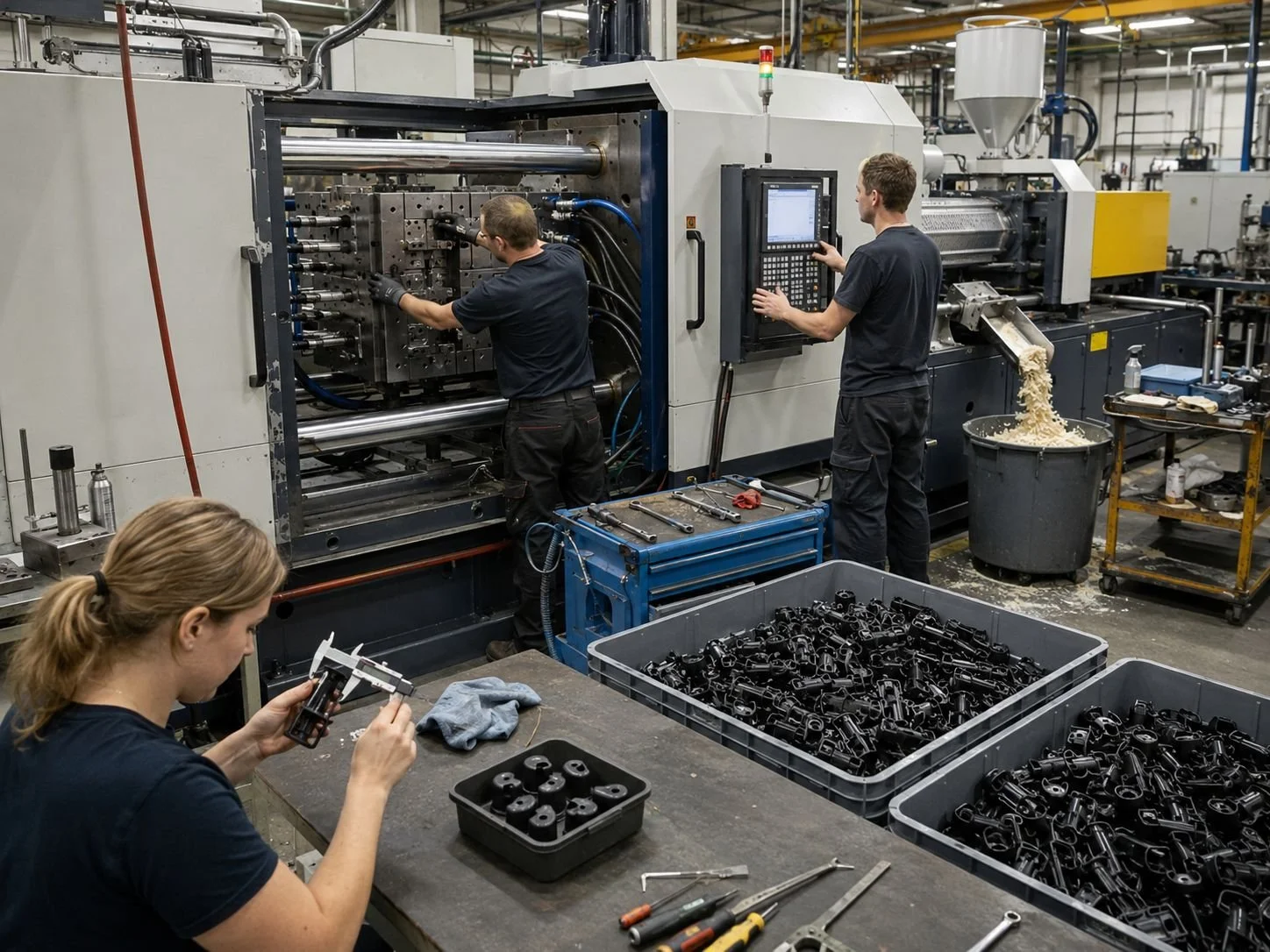
Plastic injection moulding has a fixed cost every time a machine runs a tool - regardless of whether it produces ten parts or ten thousand. That fixed cost includes:
Setup time: rigging the tool into the machine, hooking up cooling, programming the cycle
Material purge: clearing the previous polymer from the barrel, often with virgin or coloured replacement material
First-off inspection: confirming dimensions and quality before the run starts
Pack-down and clean-out at the end of the run
Setup is typically a 2 to 4 hour exercise per machine. If only 100 parts are produced after that setup, the per-part cost of setup alone makes the price uneconomical. The MOQ is essentially the volume at which setup cost is properly amortised across the parts produced.
MOQs are not a barrier we put in your way. They are the volume at which the maths works for both of us.

Combining full ISO certification with DISP accreditation, B&C Plastics provides high-quality, secure, and traceable plastic injection moulded components engineered for reliability and performance.
How MOQ interacts with tooling and pricing
Three numbers are connected: tooling cost, MOQ and per-part price. Moving any one of them affects the others.
Higher MOQ, lower per-part price: more units share the setup cost, so each part is cheaper
Lower MOQ, higher per-part price: the setup cost is concentrated across fewer parts
Multi-cavity tool, lower per-part cost: the tool produces multiple parts per cycle, but the cycles need to add up
Single-cavity tool, lower MOQ, higher per-part cost: good for low-volume products where tooling investment must stay modest
How to keep your MOQ low without breaking economics
If your forecast genuinely supports lower volumes, there are still ways to get a workable arrangement.

1. Use a single-cavity production tool
Single-cavity tools cost less to build and produce one part per cycle, which suits lower forecast volumes.

2. Run less often, in larger batches
Instead of monthly 1,000-unit runs, do quarterly 3,000-unit runs. Same annual volume, but setup is amortised across more units. Holding the resulting stock costs less than the per-part premium of constant short runs.

3. Bundle multiple SKUs into one tool
Where parts are similar in size and material, a family tool can produce multiple SKUs from one setup. This is common in product ranges that share a common chassis or fitment.

4. Forecast-based supply
Annual forecasts unlock better economics on every run. We can plan production efficiently, hold material at the right cost, and avoid expediting fees. Customers with rolling forecasts almost always pay less per part.

MOQ and recycled or circular materials
Recycled and bio-based polymers sometimes have different MOQ implications, depending on availability. Where we can use our own closed-loop recycled streams, we have flexibility on smaller quantities. Where a project specifies a particular external recycled grade, we may need a slightly higher minimum to make material procurement viable. We will be transparent either way.
Frequently asked questions

-
Talk to us. For genuinely low volumes the right answer might be CNC machining from solid plastic stock, 3D printing in a production-grade material, or a soft tool. We will recommend the lowest-friction approach for what you actually need.
-
Yes, when the economics make sense. Some customers run a single large batch for a long-life product and never need another run. Others use one-off runs for promotional, seasonal or limited-edition products. We will quote it honestly either way.
-
No. Our facility produces over 50 million components per year and we have substantial spare capacity. If a particular SKU outgrows our practical capacity for a single run, we will schedule it across multiple runs to keep delivery on time.
Ready to talk to an engineering-led plastics partner?
Whether you have a fully developed brief or a rough concept, the B&C Plastics team can help you scope, design, prototype, tool and manufacture in one place - right here in Australia.
Call us on (07) 3208 0544
Email enquiries through our contact page
Or visit our Meadowbrook facility, 20 minutes south of Brisbane

Honesty, quality and partnership - today, tomorrow and every day.